
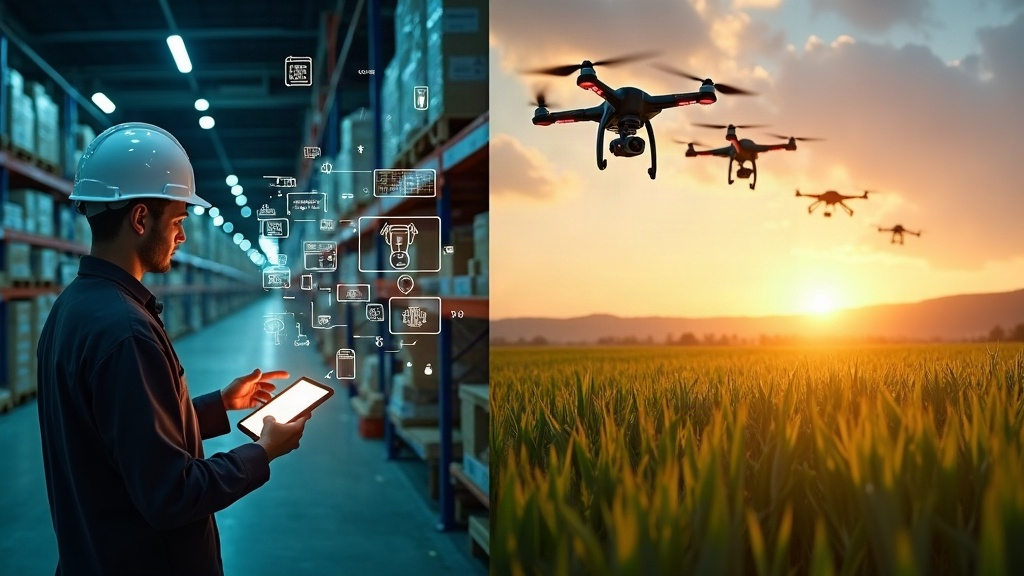
A single corn seed planted today has access to more data than entire farming communities had just 20 years ago. Sensors monitor soil moisture in real-time, drones capture multispectral images revealing plant health invisible to the human eye, and machine learning algorithms predict harvest yields with 95% accuracy.
Welcome to the agricultural revolution powered by artificial intelligence.
The numbers tell the story: farms using AI-driven precision agriculture see 20-30% increases in crop yields while reducing water usage by up to 40%. With global food demand expected to rise 70% by 2050, these aren't just impressive statistics — they're survival metrics for our planet.
What Makes Smart Farming Different from Traditional Methods?
Traditional farming relies on experience, intuition, and broad-brush approaches. A farmer might water an entire field based on visual inspection of a small section. Fertilizer gets applied uniformly across acres, regardless of soil variations.
Smart farming flips this approach. Every square meter gets individual attention based on data-driven insights.
John Deere's See & Spray technology exemplifies this shift. Their AI-powered sprayers use computer vision to identify weeds at the individual plant level, applying herbicide only where needed. Farmers report 77% reduction in herbicide usage while maintaining crop protection.
The core difference lies in precision. Traditional farming treats fields as uniform units. Smart farming recognizes that soil composition, moisture levels, and nutrient needs vary dramatically — sometimes within just a few meters.
Key smart farming technologies include:
- IoT sensors measuring soil conditions 24/7
- Satellite imagery tracking crop health across entire farms
- Machine learning models predicting optimal planting and harvesting times
- Autonomous machinery performing tasks with millimeter precision
- Weather prediction systems providing hyperlocal forecasts
This granular approach transforms farming from art to science, delivering measurable improvements in both productivity and sustainability.
How Does AI Monitor Crop Health in Real-Time?
Crop health monitoring traditionally meant walking fields and visually inspecting plants — a time-intensive process that often caught problems too late. AI changes this completely.
Multispectral imaging captures light wavelengths invisible to human eyes. Healthy plants reflect near-infrared light differently than stressed ones. AI algorithms analyze these spectral signatures to detect:
- Disease outbreaks up to 10 days before visible symptoms appear
- Nutrient deficiencies at the cellular level
- Water stress in specific field zones
- Pest infestations in early stages
Taranis, an Israeli agtech company, uses AI to analyze aerial imagery from planes and drones. Their system identifies crop threats with 95% accuracy, sending alerts directly to farmers' smartphones. One client in Argentina prevented a $2.3 million loss by catching armyworm infestations three days before they became visible to ground scouts.
Ground-based sensors provide continuous monitoring:
- Soil moisture sensors track water levels at multiple depths
- Weather stations measure temperature, humidity, and wind patterns
- Plant sensors attached to crop stems monitor growth rates and stress indicators
- Camera traps use computer vision to count beneficial insects vs. pests
Satellite monitoring offers the biggest picture. Companies like Planet Labs capture daily images of agricultural areas worldwide. AI algorithms process these images to:
- Track crop development stages across entire regions
- Identify irrigation system failures
- Monitor compliance with sustainable farming practices
- Predict regional yield variations
The integration creates a comprehensive health monitoring system. When soil sensors detect moisture stress, satellite imagery confirms the affected area, and drones provide detailed assessment — all processed by AI to recommend specific actions.
Can Machine Learning Predict Optimal Planting Times?
Timing in agriculture determines success or failure. Plant too early, and frost kills seedlings. Plant too late, and crops don't mature before the first freeze. Traditional farmers relied on almanacs and generational knowledge. AI uses decades of weather data, soil conditions, and crop performance to make precise predictions.
Climate Corporation (owned by Bayer) processes over 150 billion data points daily to create hyperlocal weather forecasts and planting recommendations. Their AI models consider:
- Historical weather patterns for specific GPS coordinates
- Soil temperature and moisture at planting depth
- Long-range weather predictions
- Seed variety characteristics and maturation times
- Market price forecasts for different harvest windows
The results are impressive. Farmers using AI-driven planting recommendations see 8-12% higher yields compared to traditional timing methods.
Microsoft's FarmBeats platform demonstrates this in action. In India, they partnered with local farmers to optimize cotton planting. The AI system analyzed:
- 30 years of local weather data
- Soil sensor readings from test plots
- Satellite imagery showing soil moisture patterns
- Regional pest and disease outbreak histories
The AI recommended planting windows that differed from traditional practices by 2-3 weeks. Participating farmers achieved 30% higher yields and reduced crop losses from unexpected weather events by 60%.
Real-time adjustments make the difference. AI doesn't just predict optimal planting dates — it continuously updates recommendations based on changing conditions. If a late spring delays soil warming, the system adjusts planting schedules across different field zones to maintain optimal growing degree day accumulation.
The technology extends beyond planting to harvest timing. AI models predict optimal harvest windows by analyzing:
- Crop maturity indicators from satellite imagery
- Weather forecasts for harvest conditions
- Market price projections
- Storage and transportation capacity
This comprehensive approach transforms planting from guesswork into precision science.
What Role Do Drones Play in Precision Agriculture?
Agricultural drones represent the eyes and hands of AI-powered farming. These flying sensors collect data impossible to gather efficiently from the ground while performing tasks with superhuman precision.
Data collection capabilities of modern agricultural drones include:
- RGB cameras for visual crop assessment
- Multispectral sensors detecting plant health indicators
- Thermal cameras identifying irrigation issues and disease hotspots
- LiDAR systems creating detailed topographical maps
- Air quality sensors monitoring environmental conditions
DJI's Agras series showcases drone versatility. Their T40 model carries 40 liters of liquid or 50kg of granular materials, covering 25 hectares per hour with centimeter-level accuracy. The drone's AI system automatically adjusts spray patterns based on wind conditions, terrain variations, and crop density.
Precision application eliminates waste and reduces environmental impact:
- Variable rate spraying applies exact amounts needed in each field zone
- Spot treatment targets only affected areas, not entire fields
- Real-time wind compensation ensures accurate chemical placement
- GPS guidance prevents overlapping or missing areas
Blue River Technology (acquired by John Deere) developed "See & Spray" drones that use computer vision to identify individual plants. Their system distinguishes between crops and weeds with 99.5% accuracy, applying herbicide only where needed. This reduces chemical usage by up to 90% while maintaining crop protection.
Monitoring and scouting capabilities transform farm management:
- Daily crop health assessments across thousands of acres
- Early detection of pest infestations or disease outbreaks
- Livestock monitoring and counting
- Infrastructure inspection (fences, irrigation systems, equipment)
- Compliance documentation for organic or sustainable farming certifications
Integration with farm management systems creates comprehensive data platforms. Drones upload imagery and sensor data to cloud platforms where AI algorithms process information and generate actionable insights. Farmers receive alerts, recommendations, and treatment maps directly on their smartphones or tablets.
The economic impact is substantial. Farmers using drone-based precision agriculture report 15-25% cost reductions in inputs (seeds, fertilizers, pesticides) while maintaining or improving yields.
How Does AI Optimize Water Usage and Irrigation?
Water scarcity affects 40% of the global population, making efficient irrigation critical for sustainable agriculture. AI-powered irrigation systems optimize water usage while maximizing crop productivity.
Smart irrigation controllers use multiple data sources to determine precise watering needs:
- Soil moisture sensors at various depths
- Weather station data and forecasts
- Evapotranspiration calculations
- Crop growth stage requirements
- Historical usage patterns
Netafim's NetBeat platform exemplifies this technology. Their AI system analyzes data from soil sensors, weather stations, and satellite imagery to create customized irrigation schedules. Farmers using the system reduce water consumption by 30-50% while increasing yields by 15-20%.
Variable rate irrigation applies different amounts of water across field zones based on specific needs:
- Soil composition variations
- Topographical differences affecting drainage
- Crop health variations requiring more or less water
- Microclimate differences within fields
CropX's soil monitoring system uses wireless sensors placed throughout fields to measure soil conditions in real-time. Their AI algorithms process this data to create irrigation maps showing exactly where and when water is needed. One California almond grower reduced water usage by 25% while improving nut quality and yield.
Predictive irrigation scheduling anticipates water needs days in advance:
- Weather forecast integration prevents unnecessary irrigation before rain
- Crop development models predict increased water needs during critical growth stages
- Soil moisture trend analysis identifies optimal irrigation timing
- Market price considerations factor into irrigation intensity decisions
Deficit irrigation strategies use AI to deliberately stress crops at specific times to improve quality or conserve water without significantly reducing yields. Wine grape producers use this technique to concentrate flavors, while tomato growers improve fruit sugar content.
The technology extends to greenhouse environments where precision is even more critical. AI systems control:
- Misting systems for humidity management
- Root zone irrigation for hydroponic systems
- Nutrient solution composition and delivery timing
- Climate control integration with irrigation scheduling
Results from real implementations demonstrate significant impact:
- Israel's agricultural sector uses 50% less water per unit of production compared to global averages
- Australian cotton farms using AI irrigation reduce water usage by 40% while maintaining fiber quality
- California vegetable producers save $1,200 per acre annually through optimized irrigation
Which Crops Benefit Most from AI Implementation?
While AI transforms agriculture across all crop types, certain characteristics make some crops particularly suitable for AI-powered optimization. High-value crops, those requiring precise timing, and crops grown in controlled environments see the greatest returns on AI investment.
Row crops (corn, soybeans, wheat) benefit enormously from AI due to their large scale and uniform planting patterns:
- Corn production sees 15-20% yield improvements through AI-optimized planting density, fertilizer application, and harvest timing
- Soybean farmers using AI-powered pest management reduce chemical inputs by 30% while maintaining protection
- Wheat operations leverage AI weather prediction to optimize harvesting windows, reducing losses from weather damage
Specialty crops command premium prices that justify AI investment costs:
Wine grapes represent a prime example. Jackson Family Wines uses AI to optimize every aspect of production:
- Soil sensors monitor moisture and nutrient levels in individual vineyard blocks
- Weather stations provide hyperlocal climate data
- Drones capture multispectral imagery to assess grape maturity
- Machine learning models predict optimal harvest dates for different quality levels
The result: 12% improvement in grape quality scores while reducing water usage by 25%.
Tree fruits and nuts benefit from AI's long-term optimization capabilities:
- Apple orchards use computer vision to count fruit and predict yields months before harvest
- Citrus groves employ AI-powered pest monitoring to prevent devastating infestations
- Almond farms optimize irrigation timing to maximize nut fill while conserving water
Vegetable production sees immediate returns from AI implementation:
Bowery Farming operates indoor farms using AI to control every environmental factor:
- LED lighting systems adjust spectrum and intensity based on plant growth stages
- Nutrient delivery systems provide precise fertilizer mixtures
- Climate control maintains optimal temperature and humidity
- Computer vision monitors plant health and growth rates
Their AI-optimized farms produce 365 times more food per square foot than traditional farming while using 95% less water.
Greenhouse crops represent the ideal AI environment:
- Tomato production in controlled environments sees 20-30% yield increases
- Lettuce and leafy greens benefit from precise nutrient management
- Flower production uses AI to optimize bloom timing for market demands
Cannabis cultivation (where legal) demonstrates AI's potential in high-value crops:
- Precise environmental control maximizes cannabinoid production
- Computer vision detects male plants before pollination
- AI-optimized curing processes improve product quality
Factors determining AI suitability include:
- Crop value per acre — higher value crops justify AI investment costs
- Production complexity — crops requiring precise timing and inputs benefit most
- Data availability — crops with established growing protocols adapt faster to AI optimization
- Market premiums — crops where quality improvements command higher prices
The key insight: AI delivers the greatest value where precision matters most and mistakes are most costly.
What Are the Real-World Success Stories?
Granular (acquired by Corteva) transformed corn and soybean farming across the Midwest. Their AI platform analyzes soil samples, weather data, and historical yields to create customized planting prescriptions.
Case study: Iowa corn farmer Mike Johnson (name changed for privacy) managed 3,200 acres using traditional methods with average yields of 180 bushels per acre. After implementing Granular's AI system:
- Yield increased to 215 bushels per acre (19% improvement)
- Fertilizer costs decreased by $45 per acre through precise application
- Fuel consumption dropped 15% through optimized field operations
- Net profit increased by $125,000 annually
The AI system identified that Johnson's fields had three distinct soil zones requiring different seed populations and fertilizer rates — insights invisible through traditional soil testing.
Indigo Agriculture revolutionizes farming through microbial seed treatments and AI-powered crop monitoring. Their platform combines satellite imagery, weather data, and on-farm sensors to optimize crop production.
Brazilian soybean operation case: A 15,000-hectare farm in Mato Grosso implemented Indigo's system:
- Satellite monitoring detected early signs of Asian soybean rust 12 days before field scouts
- AI-recommended fungicide applications prevented $2.8 million in crop losses
- Variable-rate seeding based on soil analysis improved plant stands by 18%
- Water usage decreased 30% through precision irrigation scheduling
The farm's profitability increased 22% in the first year while reducing environmental impact.
Prospera Technologies focuses on greenhouse vegetable production using computer vision and AI analytics.
Dutch tomato greenhouse success: A 50-hectare facility in the Netherlands partnered with Prospera:
- Computer vision cameras monitor 2.5 million plants continuously
- AI algorithms detect diseases, pests, and nutrient deficiencies
- Automated alerts enable intervention within hours instead of days
- Yield increased 15% while reducing pesticide use by 40%
The system identified that slight temperature variations in different greenhouse zones affected fruit development, leading to climate control adjustments that improved uniformity and quality.
Farmers Edge provides comprehensive farm management through AI and IoT integration.
Canadian wheat farm transformation: A 8,000-acre operation in Saskatchewan:
- Weather stations and soil sensors provide real-time field conditions
- Satellite imagery tracks crop development and identifies problem areas
- AI models optimize seeding rates, fertilizer timing, and harvest schedules
- Variable-rate application technology applies inputs precisely where needed
Results after three years:
- Average yield increased from 45 to 58 bushels per acre
- Input costs reduced by $35 per acre
- Crop quality improvements earned premium prices
- Total profitability improved by $280,000 annually
Vertical farming success: AeroFarms operates the world's largest vertical farm in Newark, New Jersey:
- AI controls LED lighting, nutrition, and climate for optimal plant growth
- Computer vision monitors plant health and growth rates
- Predictive analytics optimize harvest timing for maximum nutrition
- Yields are 390 times higher per square foot than field agriculture
- Water usage is 95% less than traditional farming
- No pesticides required due to controlled environment
Their leafy greens command premium prices in New York City markets while providing year-round local production.
Livestock integration: Cainthus (acquired by Merck) uses computer vision to monitor dairy cow health and behavior:
- Cameras track individual cow activity, feed intake, and health indicators
- AI algorithms detect illness, heat cycles, and lameness before visible symptoms
- Automated alerts enable early intervention
- Milk production increases 8-12% through optimized cow management
These success stories share common elements: comprehensive data collection, AI-powered analysis, and precise implementation of recommendations. The technology doesn't replace farmer expertise — it amplifies it with data-driven insights impossible to gather manually.
How Can Farmers Start Implementing AI Solutions?
The path to AI-powered farming doesn't require massive upfront investments or technical expertise. Smart implementation starts small and scales based on proven results.
Assessment phase — understand your current situation:
Evaluate your operation's readiness:
- Farm size and crop types
- Current technology adoption level
- Available capital for technology investment
- Internet connectivity and data infrastructure
- Staff technical capabilities and willingness to learn
Identify highest-impact opportunities:
- Areas where precision would generate immediate value
- Processes currently done manually that could be automated
- Historical problem areas (pest outbreaks, yield variations, input waste)
- Crops or fields with highest profit margins
Start with low-cost, high-impact solutions:
Smartphone-based applications provide immediate AI benefits:
- Climate FieldView offers satellite imagery and weather data for $7-10 per acre
- PlantNet uses computer vision to identify weeds and diseases through photos
- AgriWebb provides livestock management and grazing optimization
- FarmLogs tracks field activities and generates basic analytics
Soil testing and analysis creates the foundation for precision agriculture:
- SoilOptix uses gamma ray spectroscopy to map soil composition
- Veris Technologies provides electrical conductivity mapping
- Precision Planting offers soil compaction and moisture mapping
Weather monitoring stations improve decision-making immediately:
- Davis Instruments provides professional-grade weather stations starting at $1,500
- Onset HOBO offers wireless sensor networks for multiple field locations
- Campbell Scientific delivers research-grade meteorological systems
Gradual scaling approach:
Year 1: Foundation building
- Install basic weather monitoring
- Implement smartphone-based crop scouting
- Begin soil mapping and testing
- Start record-keeping with farm management software
Year 2: Precision implementation
- Add soil moisture sensors in key fields
- Implement variable-rate fertilizer application
- Use satellite imagery for crop monitoring
- Install GPS guidance on primary equipment
Year 3: Advanced integration
- Deploy drone technology for detailed scouting
- Implement automated irrigation controls
- Add livestock monitoring systems (if applicable)
- Integrate all systems into comprehensive farm management platform
Partnership strategies reduce implementation barriers:
Equipment dealers and manufacturers often provide:
- Financing options for technology packages
- Training programs for operators
- Technical support during implementation
- Upgrade paths as technology evolves
Agtech service providers offer:
- Turnkey solutions without equipment ownership
- Custom application services using AI-powered equipment
- Data analysis and recommendation services
- Pilot programs to demonstrate value before full commitment
University extension programs provide:
- Educational workshops on precision agriculture
- Research trial participation opportunities
- Technical assistance and troubleshooting
- Networking with other early adopters
Key success factors for AI implementation:
- Start simple — complex systems can overwhelm and discourage adoption
- Focus on ROI — prioritize solutions with clear financial benefits
- Invest in training — technology is only valuable if used correctly
- Plan for integration — ensure new systems work with existing equipment
- Measure results — track improvements to justify continued investment
Common pitfalls to avoid:
- Buying technology without understanding specific benefits
- Implementing too many systems simultaneously
- Neglecting staff training and change management
- Choosing incompatible systems that don't integrate
- Focusing on technology features instead of business outcomes
The agricultural AI revolution isn't coming — it's here. Farms implementing these technologies today gain competitive advantages that compound over time. Those waiting for "perfect" solutions risk falling behind permanently.
What Does the Future Hold for AI in Agriculture?
The next decade will transform agriculture more dramatically than the previous century. Emerging AI technologies promise to solve challenges we're only beginning to understand while creating entirely new possibilities for sustainable food production.
Autonomous farming systems are moving beyond individual machines to coordinated fleets:
Swarm robotics will deploy hundreds of small robots working together:
- Micro-robots performing precision weeding at the individual plant level
- Coordinated planting systems that adapt to real-time soil conditions
- Pollination robots supplementing declining bee populations
- Harvest robots working 24/7 during optimal picking windows
John Deere's vision of fully autonomous farms includes:
- Self-driving tractors operating continuously without human oversight
- AI-powered decision-making for all field operations
- Real-time coordination between multiple machines
- Predictive maintenance preventing equipment failures
Genetic optimization through AI accelerates crop improvement:
CRISPR gene editing combined with machine learning identifies optimal genetic modifications:
- AI analyzes millions of genetic combinations to predict crop performance
- Climate-resilient varieties developed in years instead of decades
- Nutritional enhancement targeting specific dietary needs
- Disease resistance engineered before pathogens evolve
Bayer's digital breeding programs use AI to:
- Analyze genetic markers across thousands of plant varieties
- Predict performance in different environmental conditions
- Optimize breeding decisions for faster variety development
- Create location-specific varieties for microclimate conditions
Cellular agriculture represents farming's most radical transformation:
Lab-grown food production eliminates traditional farming limitations:
- Meat production without livestock using cellular cultivation
- Dairy proteins created through precision fermentation
- Fruits and vegetables grown in bioreactors independent of seasons
- Customized nutrition profiles designed for specific health needs
Perfect Day already produces dairy proteins identical to cow milk using fermentation, requiring 97% less land and 96% less water than traditional dairy farming.
Climate adaptation becomes critical as weather patterns become less predictable:
AI-powered climate modeling provides unprecedented precision:
- Hyperlocal weather predictions with 15-minute resolution
- Long-range seasonal forecasting for planting decisions
- Extreme weather event prediction and preparation protocols
- Carbon sequestration optimization through regenerative practices
Regenerative agriculture enhanced by AI:
- Soil carbon monitoring through satellite imagery and sensors
- Cover crop optimization for soil health improvement
- Grazing pattern optimization for pasture regeneration
- Biodiversity monitoring and enhancement programs
Urban agriculture scales through AI automation:
Vertical farming expansion into urban environments:
- AI-optimized growing systems in abandoned buildings and warehouses
- Rooftop farming integrated with building management systems
- Community-supported agriculture using shared AI platforms
- Food production integrated into urban planning and design
Supply chain integration creates seamless farm-to-consumer systems:
Blockchain and AI combination provides:
- Complete traceability from seed to plate
- Quality prediction throughout the supply chain
- Demand forecasting driving planting decisions
- Waste reduction through optimized distribution
Economic transformation reshapes agricultural business models:
Data as a revenue stream:
- Farmers selling anonymized production data to research institutions
- AI insights shared across farming cooperatives
- Predictive models licensed to input suppliers and food processors
- Carbon credit optimization through AI-verified practices
The convergence of these technologies creates possibilities unimaginable today. Farms will become living laboratories where AI continuously experiments, learns, and optimizes. Food production will become more localized, sustainable, and precisely tailored to human nutritional needs.
Challenges requiring attention:
- Digital divide between large and small farms
- Data ownership and privacy concerns
- Cybersecurity risks in connected farm systems
- Regulatory frameworks lagging behind technological capabilities
- Workforce transformation requiring new skills and training
The farms of 2035 will look nothing like today's operations. AI won't just optimize existing practices — it will fundamentally reimagine how we produce food. Early adopters are positioning themselves not just for better yields, but for entirely new ways of farming that haven't been invented yet.
Smart farming represents more than technological advancement — it's essential for feeding a growing global population while protecting our planet's resources. The question isn't whether AI will transform agriculture, but how quickly farmers can adapt to lead this transformation.
We've seen how AI revolutionizes every aspect of farming, from precision planting to autonomous harvesting. The technology exists today to dramatically improve yields, reduce environmental impact, and increase profitability. Success requires starting with focused implementations and scaling based on proven results.
The agricultural AI revolution rewards early adopters with competitive advantages that compound over time. Those implementing smart farming technologies today are building the foundation for tomorrow's food security.
Ready to build your AI strategy together? Book a free consultation.